|
Bird
TLC
Kids Page

Check out the fun
things on this page for our young Hawk Supporters.
Check
out the Bird TLC blog. Current stories of Bird TLC's birds and people.

|
Welcome Hawk
Sponsors
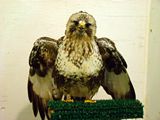
This rough-legged hawk came to us
from ........
This winter visitor is
a large, soaring hawk named for the feathers that extend down its legs, an
adaptation to its northern habitat. Rough-legged Hawks are variable in
plumage, with light and dark color phases and variations in between. Dark
phases account for only ten percent of western Rough-legged Hawks. Adults are
generally mottled light-and-dark underneath, with dark patches at the wrists.
Seen from below, the tails of both phases appear light with a dark terminal
band. Seen from above, both phases appear mostly dark, but the light phase
shows a light tail with a dark terminal band, and the tail of the dark phase
appears dark all over. The adult male can have several dark bands at the tip
of its tail as compared to the female, which only has one band. The light
phase has a distinctive light-colored head, in contrast to its dark upperside.
The Rough-legged Hawk's bill and feet are relatively small.
Rough-legged Hawks
nest in the Arctic, both in the Old and the New World, mostly in tundra. They
also use the northern edge of boreal forest. In winter, they inhabit open
fields, plains, marshes, and farmland.
They are usually found
singly or in pairs; only rarely are they seen in large groups. They hunt by
watching from a perch. Because of their small feet, they are able to stand on
a thin perch. They patrol low over the ground, or hover high over a field,
watching for movement, then swooping down, talons first, to grab prey.
On the breeding grounds of the
Rough-legged Hawk, lemmings are an important food source. Voles, mice,
ground squirrels, and other small mammals are part of the diet at other
times of the year. They have also been known to eat carrion, especially in
the winter.
Nests are built on
cliffs, slopes, atop large rocks, or on the ground, or, when there are trees
nearby, in a tree. The bulky nest is made of sticks, bones, and other debris,
lined with twigs, grass, and other fine material. The female incubates the 3
to 5 eggs for 31 days while the male brings her food. The female broods the
young, and the male continues to provide them all with food. After a few
weeks, the female joins in the hunting. The young first begin to fly at 5 to 6
weeks of age, but remain with the adults for another 3 to 5 weeks.
Birds leave their Arctic breeding
grounds in late fall, with only a few migrating farther south than the central
United States. Migrants come to Washington from points north, usually from
early October throughout November. The birds return to the Arctic early in
spring.
Rough-legged Hawk populations
vary considerably from year to year, following the population cycles of their
lemming prey. These fluctuations make it difficult to assess trends, but
Christmas Bird Count data reflect an increase throughout the Northwest over
the past 30 years, and the population appears to be healthy.
Bird TLC.... For the Birds!
With your support, we will continue to
provide primary medical care and rehabilitation for sick, injured, or orphaned
wild birds; and to provide environmental education for the public through live
wild bird programs.
Bird
TLC's website main page
For more Bird
TLC pictures, go to http://birdtlc.smugmug.com
|
Since
1988
Read the latest
Rehab Round Up by Cindy

Read
the latest Flight Feather online. It's Bird TLC's official newsletter.

Sign
up to receive Bird E Seeds.
Bird
TLC news delivered right to your email box.

|